
CODECHECK Certificate 2026-015
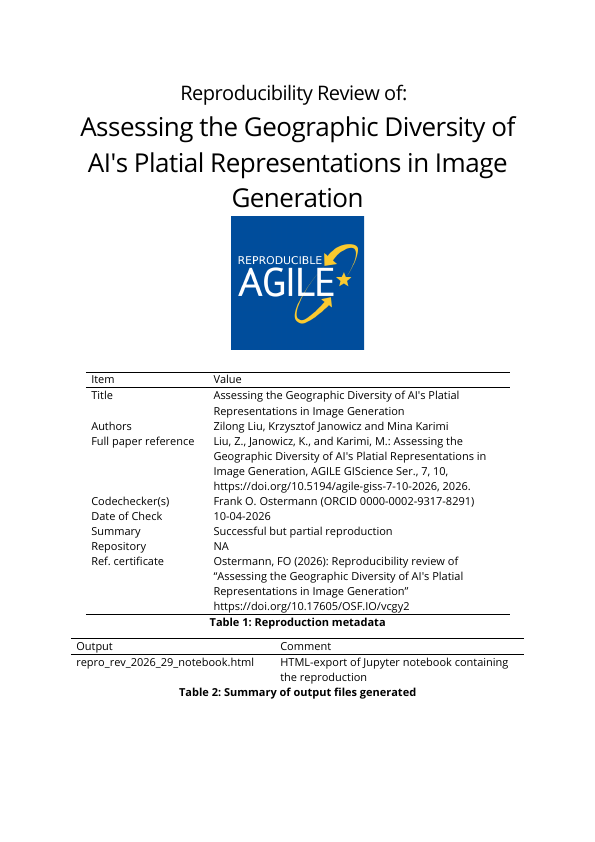
Paper details
Title: Assessing the Geographic Diversity of AI’s Platial Representations in Image Generation
Authors: Zilong Liu , Krzysztof Janowicz , Mina Karimi
Abstract: Obtained from CrossRef
Work publication date: 2026-06-10
OpenAlex: https://openalex.org/W7164183500
CODECHECK details
Certificate identifier: 2026-015
Codechecker name: Frank O. Ostermann
Time of check: 2026-04-10
Repository: https://github.com/reproducible-agile/reviews-2026|reports/029
Full certificate: https://doi.org/10.17605/OSF.IO/VCGY2
Certificate on Wikidata: Q141269759
Type: conference
Venue: AGILEGIS
Summary:
Successful but partial reproduction. The third part of the analysis reproduced smoothly, with all figures identical to the ones produced for the paper.
Cite this certificate: Citation metadata retrieved from data.crosscite.org
https://codecheck.org.uk/ | codecheckers | Zenodo Community | ResearchEquals Collection
© team@cdchck.science | Published under CC BY-SA 4.0

