
CODECHECK Certificate 2026-019
Paper details
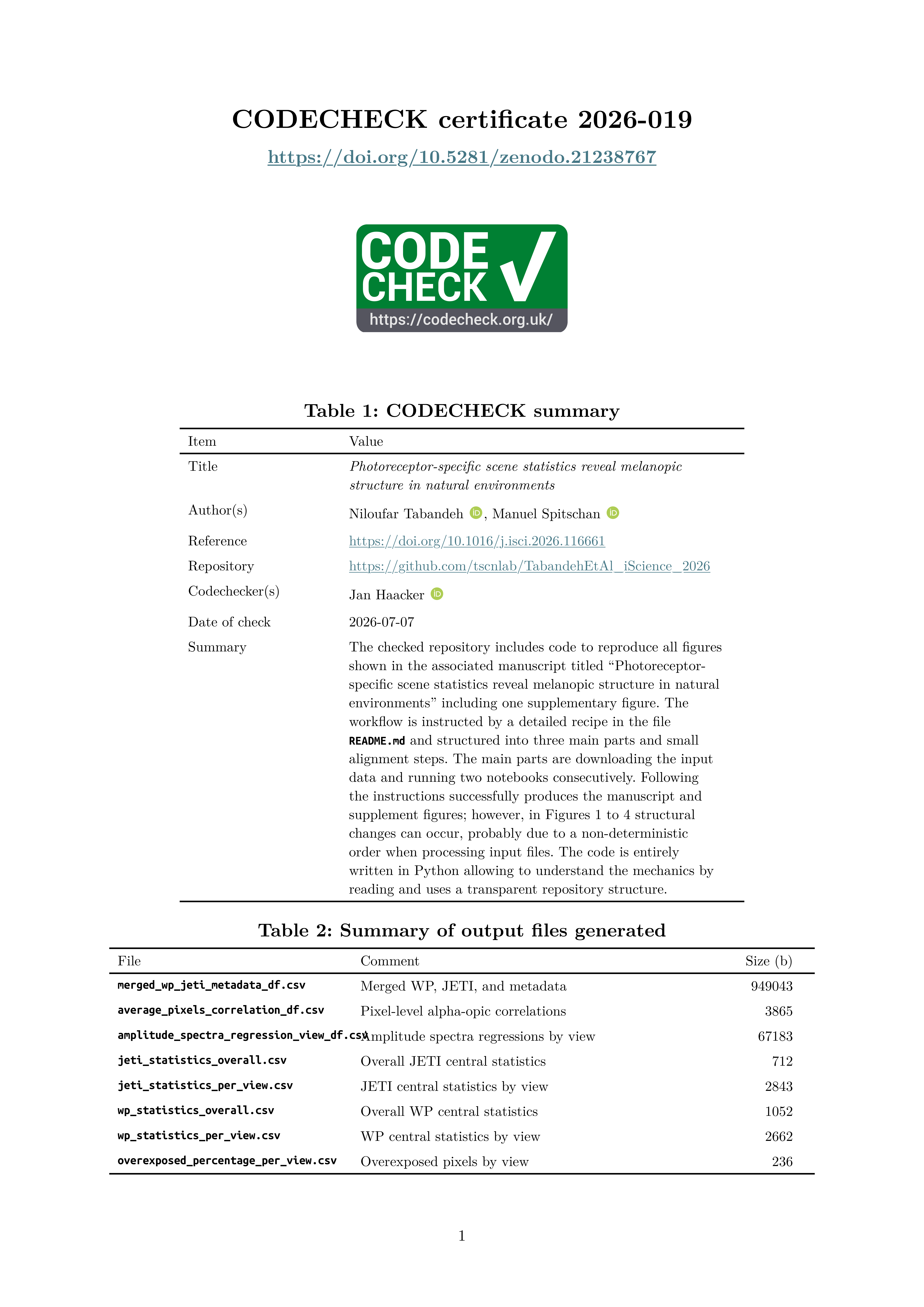
Title: Photoreceptor-specific scene statistics reveal melanopic structure in natural environments
Authors: Niloufar Tabandeh , Manuel Spitschan
Abstract: Obtained from OpenAlex
Natural scenes shape visual perception and non-visual responses, yet the melanopsin pathway, the retina’s key circadian input, is rarely quantified in this context. We measured spectral and spatial properties of 671 natural scenes: indoor scenes without windows ( n = 115), indoor scenes with windows ( n = 194), and outdoor scenes ( n = 362), across all five human photoreceptors. Radiance and photometric metrics increased systematically from windowless indoor view (mean melanopic EDI 280 lx) to indoor scenes with window view (2386 lx) to outdoor scenes (12,142 lx), with melanopic and photopic illuminance strongly correlated ( r > 0.98, p < 10 −5 ). Beyond overall α -opic exposure, melanopic input exhibited structured spatial variation. The image-level root-mean-square (RMS) contrast ranged from 0.001 to 0.365 across categories (lowest in indoor scenes and highest outdoors), and correlated with melanopic luminance indoors with windows (r = 0.495) and outdoors (r = 0.477) but not windowless scenes (r = 0.026). Melanopic amplitude spectra followed 1/ f -like power laws, steeper slopes indoors (modal ≈ − 1.4 ) and flatter outdoors (modal ≈ − 1.1 ), revealing photoreceptor-resolved regularities in natural melanopic input.
Work publication date: 2026-08-01
OpenAlex: https://openalex.org/W4416186252
CODECHECK details
Certificate identifier: 2026-019
Codechecker name: Jan Haacker
Time of check: 2026-07-07
Repository: https://github.com/codecheckers/certificate-2026-019
Full certificate: https://doi.org/10.5281/zenodo.21238767
Certificate on Wikidata: Q141269763
Type: community
Venue: codecheck
Summary:
The checked repository includes code to reproduce all figures shown in
the associated manuscript titled “Photoreceptor-specific scene
statistics reveal melanopic structure in natural environments” including
one supplementary figure. The workflow is instructed by a detailed
recipe in the file README.md and structured into three main
parts and small alignment steps. The main parts are downloading the
input data and running two notebooks consecutively. Following the
instructions successfully produces the manuscript and supplement
figures; however, in Figures 1 to 4 structural changes can occur,
probably due to a non-deterministic order when processing input files.
The code is entirely written in Python allowing to understand the
mechanics by reading and uses a transparent repository structure.
Cite this certificate: Citation metadata retrieved from data.crosscite.org
https://codecheck.org.uk/ | codecheckers | Zenodo Community | ResearchEquals Collection
© team@cdchck.science | Published under CC BY-SA 4.0

