
CODECHECK Certificate 2026-025
Paper details
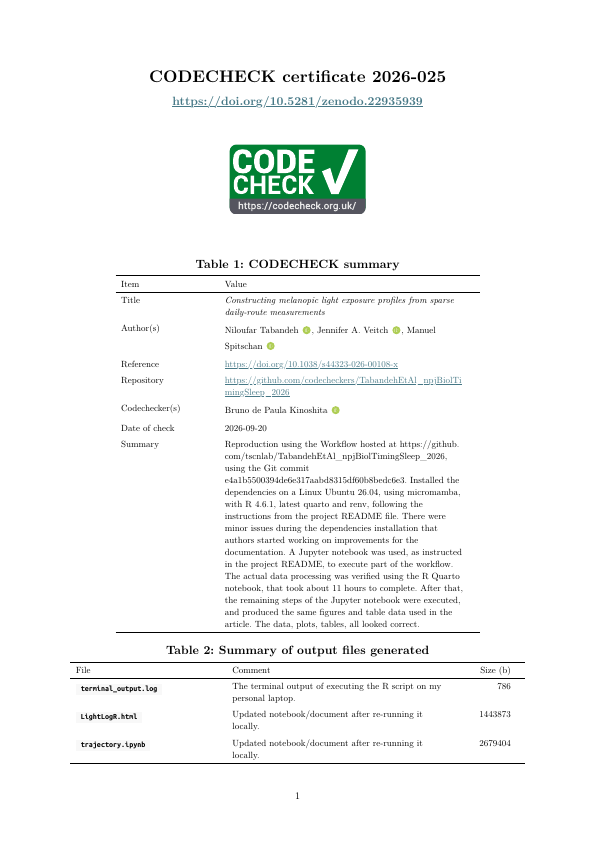
Title: Constructing melanopic light exposure profiles from sparse daily-route measurements
Authors: Niloufar Tabandeh , Jennifer A. Veitch , Manuel Spitschan
Abstract: Obtained from CrossRef
Work publication date: 2026-10-16
OpenAlex: https://openalex.org/W7222584248
CODECHECK details
Certificate identifier: 2026-025
Codechecker name: Bruno de Paula Kinoshita
Time of check: 2026-09-20
Repository: https://github.com/codecheckers/TabandehEtAl_npjBiolTimingSleep_2026
Full certificate: https://doi.org/10.5281/zenodo.22935939
Certificate on Wikidata: Q141668973
Type: community
Venue: codecheck
Summary:
Reproduction using the Workflow hosted at https://github.com/tscnlab/TabandehEtAl_npjBiolTimingSleep_2026, using the Git commit e4a1b5500394de6e317aabd8315df60b8bedc6e3. Installed the dependencies on a Linux Ubuntu 26.04, using micromamba, with R 4.6.1, latest quarto and renv, following the instructions from the project README file. There were minor issues during the dependencies installation that authors started working on improvements for the documentation. A Jupyter notebook was used, as instructed in the project README, to execute part of the workflow. The actual data processing was verified using the R Quarto notebook, that took about 11 hours to complete. After that, the remaining steps of the Jupyter notebook were executed, and produced the same figures and table data used in the article. The data, plots, tables, all looked correct.
Cite this certificate: Citation metadata retrieved from data.crosscite.org
https://codecheck.org.uk/ | codecheckers | Zenodo Community | ResearchEquals Collection
© team@cdchck.science | Published under CC BY-SA 4.0

